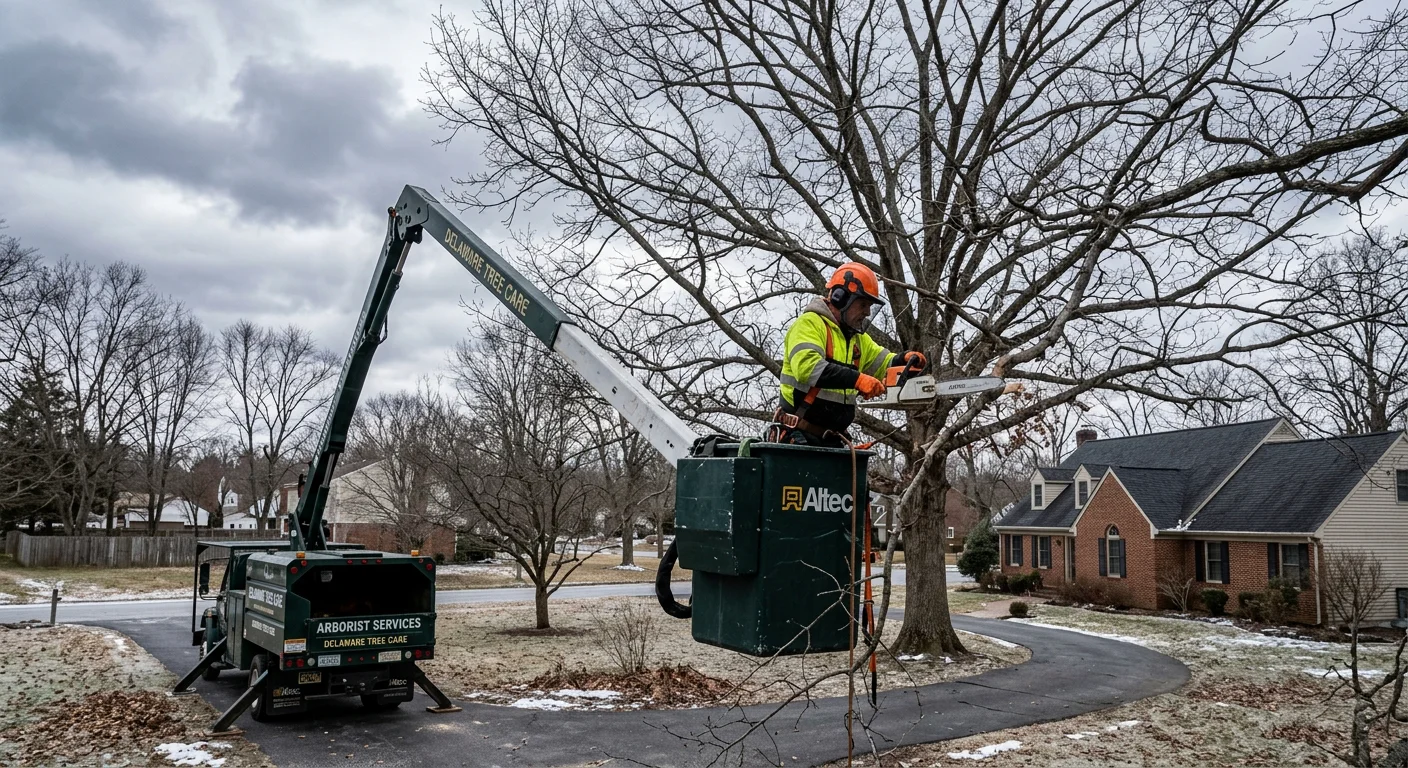
If you own property in Wilmington, Newark, Hockessin, or anywhere in New Castle County, Delaware, knowing when to schedule tree trimming can save your trees — and your money. In Delaware’s Mid-Atlantic climate, tree trimming timing affects how quickly pruning wounds heal, what pests or diseases might enter, and how much stress the work puts on your trees overall.
This guide covers the best seasonal windows for tree trimming across the species most common in New Castle County, and explains what to avoid and why.
The General Rule for Delaware Tree Trimming: Late Winter Is Best
For the majority of deciduous tree species common in New Castle County — oaks, maples, silver maples, tulip poplars, ash, sweetgum — late winter (mid-February through March) is the optimal pruning window.
Here’s why late winter works so well for Delaware trees:
Trees are dormant. Without leaves to sustain, the tree is running at minimal metabolic activity. Pruning wounds don’t need to compete with active growth for resources.
Cuts close fastest. The spring growth flush immediately follows late winter pruning, which means woundwood (callus) begins forming within weeks. Large pruning wounds that might take a full summer to begin callusing if pruned in July will start closing by April if pruned in February.
Structure is visible. Without leaves, you can see the full branch architecture — crossing branches, included bark at stem unions, and deadwood that’s hidden in the summer canopy. Better visibility means better pruning decisions.
Pest and disease pressure is low. Many of the most serious tree pathogens and insect pests are inactive in winter, reducing the risk of wound colonization. This is particularly important for oak wilt prevention (see below).
Lower demand = scheduling flexibility. Late winter is one of our lower-demand seasons in New Castle County, which means we can often schedule within 1–2 weeks rather than the 3–5 week waits that summer pruning requests can generate.
Species-by-Species Tree Trimming Timing for New Castle County, DE
Oaks (White Oak, Red Oak, Pin Oak)
Best: Late fall through early February Avoid: April through July
Oaks have a specific disease risk — oak wilt — that makes spring timing genuinely dangerous for Delaware homeowners. Oak wilt (Ceratocystis fagacearum) is spread by sap beetles that are most active from April through July, attracted to fresh tree wounds and pruning cuts. In Delaware, oak wilt has been confirmed in New Castle County, and the consequences for red oaks particularly are severe — the disease can kill a red oak within a single growing season.
Prune oaks between October and February when sap beetle activity is minimal. If you absolutely must prune an oak during the risk window (for hazard removal), paint all cuts immediately with wound sealant — an unusual measure that is specifically justified for oak wilt prevention.
Maples (Silver Maple, Red Maple, Sugar Maple)
Best: Late winter (February–March) Acceptable: Fall (October–November) Avoid: Early spring
Silver maples and red maples produce sap heavily in late winter and early spring. Pruning during heavy sap flow (late January–early March in Delaware) results in “bleeding” from cuts that looks alarming but is actually not harmful to the tree. If the bleeding bothers you aesthetically, wait until early April after sap flow has slowed.
For structural pruning of the large silver maples common in Wilmington, Brandywine Hundred, and Elsmere, February is the sweet spot — dormant enough to avoid sap flow, but cuts will close by late spring.
Tulip Poplar
Best: Late winter through early spring Acceptable: Late fall
Tulip poplars are vigorous growers that respond well to pruning almost year-round. Late winter is best for the same reasons as maples. Avoid pruning in midsummer (July–August) when heat stress is highest — fresh cuts on a heat-stressed tree compete with the tree’s drought management mechanisms and slow recovery.
White Ash, Green Ash
Special consideration: EAB status determines priority over timing
For ash trees in New Castle County that are still healthy enough to prune (less than 30% canopy loss), pruning timing matters less than the overall management question of whether to treat for EAB. If you have a healthy ash that you’ve decided to protect with systemic treatment, prune it in late winter before starting the treatment program. If your ash is in significant decline, skip pruning and focus on the removal-vs-treatment decision.
Dogwoods (Flowering Dogwood)
Best: Late fall through early winter (October–December) Avoid: Wet, rainy spring periods
Dogwoods are susceptible to dogwood anthracnose (Discula destructiva), a fungal disease that’s most aggressive during cool, wet spring weather — exactly the conditions Delaware’s springs frequently produce. Pruning in late fall allows cuts to begin callusing before the following spring’s disease pressure peak. Spring pruning in rainy conditions can introduce anthracnose spores directly into fresh cuts.
Ornamental Trees (Redbud, Cherry, Serviceberry, Crabapple)
Best: Late fall through early February
Most spring-flowering ornamentals bloom on last year’s growth — so timing the pruning after bloom (rather than in late winter before bloom) is a reasonable choice if you want to see the full flower display. For structural issues, late fall pruning gets the work done before growth resumes.
Redbud caution: Eastern redbud is susceptible to Botryosphaeria canker, which enters through pruning wounds made with unsterilized tools. Ensure any company pruning your redbud sterilizes their cutting tools between trees. We do this as standard practice.
Evergreens (White Pine, Norway Spruce, Arborvitae)
Best: Late March through April for pines; late summer/fall for most other conifers
White pine is pruned best in late March–April just as new growth “candles” are forming but before they elongate fully. Removing the tips of the candles at this stage controls growth and maintains density without leaving large permanent cuts.
For Norway spruce and arborvitae common in Hockessin, Greenville, and Pike Creek neighborhoods, late summer (August) to fall is preferable — new growth has hardened, but there’s still enough warm weather for minor wound closure before winter.
Tree Trimming Practices to Avoid Year-Round in New Castle County
Tree topping. Topping — cutting main leaders to reduce height — is harmful regardless of season. It creates enormous wounds that won’t close properly, generates vigorous but structurally weak regrowth, and significantly shortens tree life. If height reduction is needed, proper crown reduction (cutting back to lateral branches) accomplishes the goal without topping’s damage.
Lion-tailing. Removing all inner branches to leave tufts of foliage only at branch tips. This creates “end-heavy” branches that are far more prone to storm failure than well-pruned branches with distributed foliage.
Excessive removal. Removing more than 25–30% of a tree’s live canopy in a single pruning session should be avoided in most cases. Heavy removal stresses the tree significantly and can cause a flush of weakly-attached “water sprouts” as the tree desperately tries to restore its canopy.
When Timing Doesn’t Apply: Hazard Removal in Delaware
If a branch is a safety hazard — large deadwood over an occupied area, a cracked limb that could fail, a branch actively contacting your roof in Wilmington or anywhere in New Castle County — timing is irrelevant. Remove the hazard. Tree health considerations yield to safety in every case. Call (302) 588-3955) and we’ll assess whether it’s an emergency or can wait for the optimal seasonal window.
Schedule Tree Trimming Early in New Castle County
If you want late winter pruning — the optimal window for most Delaware trees — the time to schedule is in December or January before the rush builds. We serve all of New Castle County from Wilmington to Middletown, and our late winter schedule fills faster than any other time of year.
Call (302) 588-3955) or request a free estimate online. We’ll assess your trees, tell you what needs attention and when, and give you a written quote you can schedule at your convenience.
Related Reading:
- Tree Trimming vs. Tree Removal: How to Decide — When timing isn’t the question — removal might be
- 7 Signs Your Tree Needs to Be Removed — Some trees are past the point where trimming helps
- When Does a Leaning Tree Become Dangerous? — Safety hazards override seasonal timing every time
Frequently Asked Questions: Tree Trimming in Delaware
When is the best time to trim trees in Wilmington, DE?
Late winter — mid-February through March — is the best time to trim most deciduous trees in the Wilmington area and across New Castle County. Trees are dormant, pruning wounds close fastest with the spring growth flush, structure is fully visible, and pest/disease pressure is at its lowest. The exception is oaks, which should be pruned between October and early February to avoid the oak wilt risk window (April–July).
Can trees be trimmed in the summer in New Castle County?
Yes, trees can be trimmed in summer, but it’s not ideal for most species. Summer pruning stresses trees during their peak metabolic activity, wounds are slower to close in heat, and disease pressure from insects and fungal pathogens is highest. Summer is appropriate for light clearance work, removing dead branches, or urgent hazard removal — but structural pruning is better deferred to late winter when possible.
How much does tree trimming cost in New Castle County, DE?
Tree trimming in New Castle County typically runs $200–$800 for standard residential trees. Large trees requiring significant rigging or multiple large cuts can reach $1,000–$2,000. We provide free written estimates — call (302) 588-3955 or request online. Scheduling in the winter off-season sometimes allows for faster booking and greater crew availability.
How often should I have my trees trimmed in Delaware?
Most mature deciduous trees in New Castle County benefit from a professional assessment every 3–5 years and trimming as needed. Young trees (under 10 years) benefit from corrective structural pruning every 2–3 years to build good form before problems become large. Ornamentals and fruit trees often need more frequent attention. We’ll give you a specific maintenance recommendation at the estimate visit based on your trees’ species and condition.
Is it okay to trim trees in the fall in Delaware?
Fall (October–November) is an acceptable window for most species — it’s not as ideal as late winter but significantly better than spring or summer pruning. It’s actually a recommended timing for dogwoods and some ornamentals. Avoid trimming oaks after the sap beetles return in late spring, and don’t prune in fall if the trees are still under drought stress from a dry summer — wait until they’ve fully gone dormant.
Can I trim a tree that’s near power lines in Wilmington?
No — trimming trees that contact or are close to power lines requires coordination with Delmarva Power and should only be done by qualified crews with the proper equipment and clearances. Call us and we’ll assess the situation and handle the Delmarva Power coordination if needed. Do not attempt to trim branches near active power lines yourself.
What areas in Delaware do you serve for tree trimming?
All of New Castle County: Wilmington, Newark, Bear, New Castle, Middletown, Hockessin, Greenville, Brandywine Hundred, Pike Creek, Claymont, Elsmere, Christiana, and Odessa. Free estimates throughout the service area — call (302) 588-3955.