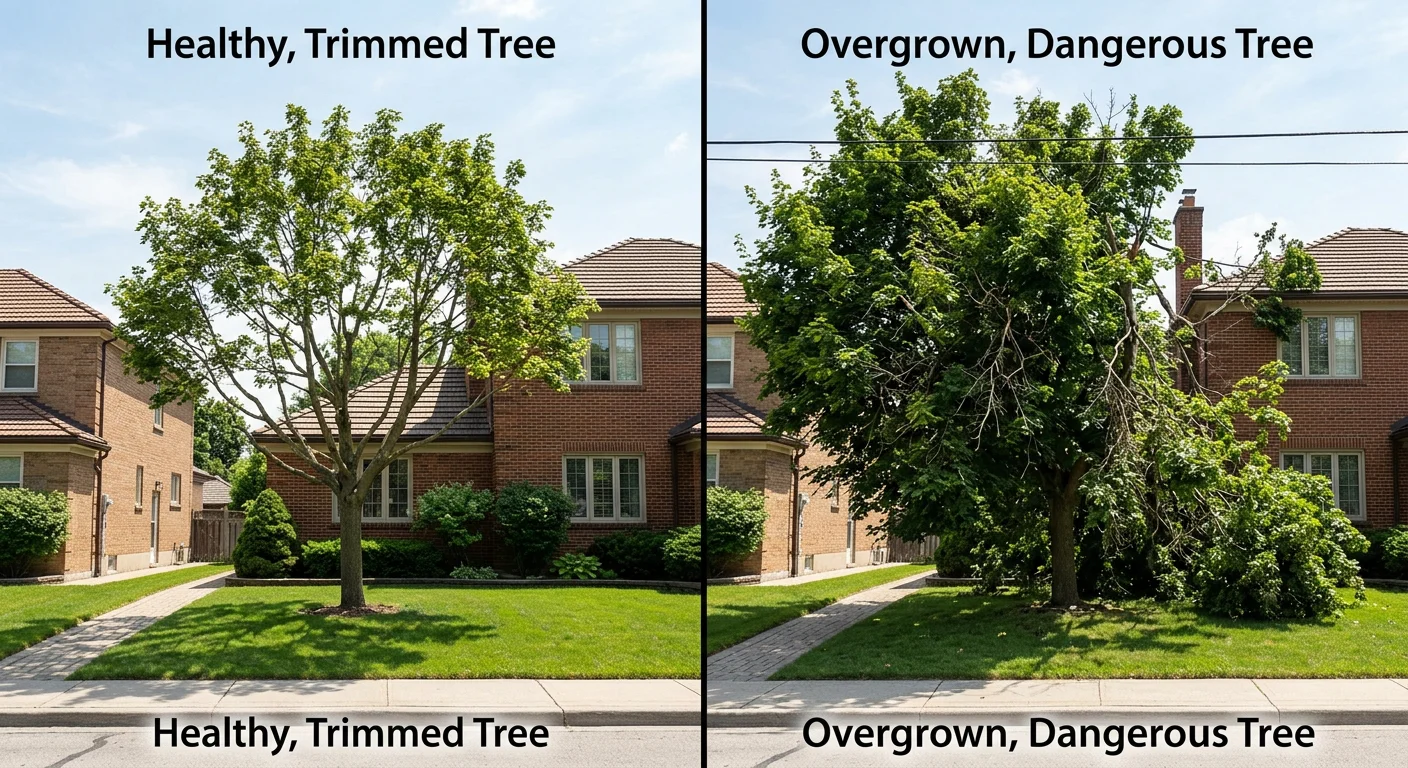
If you own property in Wilmington, Newark, Bear, or anywhere in New Castle County, Delaware, the question of whether to trim or remove a tree is one you’ll likely face at some point. It’s the most common question we hear during estimate visits: “Does this tree need to come down, or can we trim it?”
It’s a good question to ask. Tree removal is permanent — once a tree is gone, it’s gone. And many trees that homeowners assume need removal can be managed successfully with tree trimming, improving both safety and the property’s long-term value. At the same time, trimming a tree that genuinely needs removal is a temporary fix that delays an inevitable cost while adding risk.
Here’s how we evaluate the tree trimming vs. tree removal decision for the most common situations we encounter across New Castle County.
When Tree Trimming Can Solve the Problem in Delaware
The Issue Is Clearance, Not Structure
If your concern is branches overhanging your roof, touching your siding, brushing power lines, or blocking a sight line from your driveway in Wilmington or Newark, trimming is almost always the right answer — not removal.
Clearance pruning removes the specific branches causing the problem while leaving the tree intact. For most New Castle County properties, a properly pruned tree provides better long-term value than a removed tree: shade, privacy screening, wildlife habitat, and property aesthetic are all lost with removal.
The Tree Has Good Structural Health
A tree with one problematic branch — a large deadwood section, a co-dominant stem, a crossing limb that’s beginning to damage bark — can almost always be addressed with targeted structural pruning. The key question is whether the problem is isolated or whether it reflects widespread structural or health decline.
A professional tree assessment evaluates the ratio of live to dead wood, the attachment quality of major branches, root zone integrity, and overall canopy density. A tree with good structural bones and one or two specific issues is a strong candidate for pruning over removal.
The Species Responds Well to Pruning
Some species tolerate significant pruning and recover vigorously. Oaks, maples, sycamores, and most fruit trees fall into this category. Others are more sensitive — white pines, for example, can’t replace removed interior branches, and over-pruned pines decline faster than they would with minimal intervention.
For New Castle County’s most common species:
- Silver maple: Tolerates pruning well but has such a short lifespan that significant investment in structural pruning on a 60-year-old specimen may not be cost-justified
- Pin oak: Responds very well to structural pruning; good candidate for correction of co-dominant stems when caught at 10–20 years old
- Tulip poplar: Tolerates selective dead wood removal well; avoid heavy crown reduction
- White oak: Excellent candidate for conservative structural pruning; avoid topping or heavy reduction
The Tree Is Valuable and in a Key Location
Before removing any tree, consider what you’re losing. A 60-foot white oak that took a century to grow cannot be replaced in your lifetime. A mature screen planting that provides summer privacy will take 15–20 years to re-establish. In Hockessin, Greenville, and Brandywine Hundred — where mature tree canopy is a major property asset — the permanent loss of a significant tree deserves careful consideration before removal.
When Tree Removal Is the Right Answer in New Castle County
Internal Decay Exceeds Structural Threshold
Once internal decay has progressed to a point where the trunk or major scaffold branches can no longer bear expected loads — particularly in trees near structures — no amount of pruning changes that fundamental structural reality. Pruning removes canopy weight (which can help), but it can’t restore decayed wood.
A rough threshold: when decay has compromised more than 30–40% of the trunk’s cross-section at a critical point, and the tree’s fall zone includes a structure, removal is the responsible choice.
More Than 50% of the Canopy Is Dead or Declining
A tree that has lost more than half its live canopy is unlikely to recover, regardless of the cause. It may linger for years — declining slowly — but the trajectory is generally downward. Managing a tree in this condition through repeated pruning creates ongoing expense without meaningfully extending the tree’s safe life.
This threshold becomes especially relevant for EAB-infested ash trees across New Castle County. An ash tree with 50%+ canopy die-back from EAB infestation is past the economical treatment window. Planned removal is better than emergency removal when the tree eventually fails.
The Co-Dominant Stem Structure Is Unfixable
Bradford pears in Bear, Glasgow, and Middletown neighborhoods are the clearest example of this in New Castle County. By the time these trees reach 20+ years, the co-dominant stem arrangement has developed included bark so significant that no amount of pruning corrects it. Weight reduction through pruning can delay failure, but it can’t change the fundamental structural geometry that makes these trees dangerous.
For younger co-dominant trees (under 15 years), structural pruning to eliminate the weaker stem is often viable. For mature trees with equal-diameter co-dominant stems and significant included bark, removal and replacement with a better-structured species is usually the more honest recommendation.
The Location Creates Unacceptable Consequence
A structurally marginal tree in an open field with no fall-zone consequences can be managed conservatively — monitor, prune where helpful, let it live out its life. The same tree positioned where its fall zone reaches an occupied structure in Wilmington, Elsmere, or Claymont represents unacceptable risk even if its structural issues are mild.
Location changes the math fundamentally. We assess every tree in the context of its fall zone, what’s in it, and how often that space is occupied.
The Tree Is an Invasive Species
Certain species we commonly remove in New Castle County should be removed regardless of their structural health: tree-of-heaven (Ailanthus altissima), Norway maple, and Bradford pear are the three most common. These species are invasive non-natives that outcompete and displace native vegetation, host invasive pests (spotted lanternfly particularly favors tree-of-heaven), and in the case of Bradford pear, are structurally unsuitable regardless of age.
Removing these species and replacing with native alternatives — oaks, maples, serviceberries, dogwoods — is both ecologically and practically the right long-term choice for New Castle County properties.
Our Assessment Process for New Castle County Homeowners
We don’t charge for estimates, and we don’t make assumptions without seeing the tree. Our assessment process:
- Visual inspection from multiple sides and distances, noting canopy density, symmetry, and visible structural issues
- Close inspection of the root collar and lower trunk for fungal growth, cavities, and cracking
- Trunk tap test for internal decay
- Branch structure evaluation — co-dominant stems, included bark, crossing branches
- Site risk assessment — fall zone, what’s in it, frequency of occupancy
- Species-specific considerations — lifespan, structural characteristics, response to pruning
We give you our honest recommendation. If trimming is the right answer, we’ll say so and explain what work is needed. If removal is the better path, we’ll explain why. We don’t upsell removal when pruning is appropriate, and we don’t recommend ongoing expensive pruning programs when a tree genuinely needs to come down.
Call (302) 588-3955 or request a free estimate online. We serve Wilmington, Newark, Bear, New Castle, Middletown, Hockessin, Greenville, Brandywine Hundred, Pike Creek, Claymont, Elsmere, Christiana, Odessa, and all of New Castle County, Delaware.
Related Reading:
- 7 Signs Your Tree Needs to Be Removed — Know the warning signs before the decision gets made for you
- How Much Does Tree Removal Cost in Delaware? — Real price ranges for New Castle County
- Best Time to Trim Trees in Delaware — Species-by-species seasonal guide
Frequently Asked Questions: Tree Trimming vs. Removal in Delaware
How do I know if my tree needs trimming or removal in Wilmington, DE?
The key indicators for removal are: internal trunk decay, active root failure (recent lean with soil heaving), co-dominant stems with significant included bark, more than 50% dead canopy, or a fall zone that reaches your home. If none of those apply and the issue is specific branches or clearance, trimming is usually the right path. When in doubt, a free site assessment from our licensed and insured crew will give you a clear answer.
How much does tree trimming cost in New Castle County?
Tree trimming in New Castle County typically runs $200–$800 for most residential trees, depending on size, number of cuts, access, and whether wood disposal is included. Large trees requiring significant rigging can exceed $1,000. We provide free written estimates — call (302) 588-3955.
Can trimming a dangerous tree make it safe?
Trimming can reduce load on structurally compromised branches and improve wind resistance, but it cannot fix fundamental structural problems like trunk decay, root failure, or co-dominant stems with included bark in mature trees. If the hazard is caused by a specific bad branch, removal of that branch can absolutely address the risk. If the hazard is the trunk or root system, trimming buys time at best.
How often should trees be trimmed in Delaware?
Most mature deciduous trees in New Castle County benefit from a structural assessment every 3–5 years and trimming as needed. Young trees benefit from earlier corrective pruning (removing co-dominant stems before they’re large) to build good structure. Fruit trees and ornamentals often need annual or biennial attention. We’ll give you a realistic maintenance recommendation at the estimate visit.
What time of year is best for tree trimming in New Castle County?
Late winter (February–March) is optimal for most deciduous species — trees are dormant, cuts close fast with spring growth, and structure is visible without leaves. Oaks should be trimmed between October and early February specifically to avoid oak wilt risk during the April–July sap beetle season. For safety-related trimming, any time of year is appropriate — hazard removal doesn’t wait for optimal timing.
Do you remove the debris after trimming or removal?
Yes — all debris (branches, chips, brush) is removed from your property as part of standard service. For removal jobs, we chip all branch material on-site and haul it away. Large log sections can be left on-site (some homeowners want firewood) or hauled — specify your preference at the estimate.
What areas in Delaware do you serve for tree trimming and removal?
We serve all of New Castle County: Wilmington, Newark, Bear, New Castle, Middletown, Hockessin, Greenville, Brandywine Hundred, Pike Creek, Claymont, Elsmere, Christiana, and Odessa.