If you own property in Wilmington, Newark, Bear, or anywhere in New Castle County, Delaware, knowing when a tree needs to be removed could protect your home, your family, and your wallet. Every year, trees that homeowners assumed were fine come down in storms — on roofs, across driveways, and onto vehicles. Many of those trees were showing warning signs for months, sometimes years, before they failed.
This guide covers the seven most important indicators that a tree needs professional tree removal in New Castle County, based on what our licensed and insured crew sees most often across Wilmington and surrounding Delaware communities.
1. Significant Lean That Wasn’t There Before
A tree that has always grown at a slight angle because of light competition is different from a tree that recently started leaning. Recent lean — particularly if accompanied by soil heaving or cracking at the base on the opposite side — indicates root failure.
In Wilmington’s older neighborhoods, silver maples and pin oaks on clay-heavy soils are most prone to sudden lean development after extended wet periods. Saturated soil loses its grip on root systems that may already be compromised by decay. If your tree in Wilmington, Brandywine Hundred, or Hockessin is leaning noticeably more than it did last season, don’t wait for the next storm to find out whether it’s structurally sound.
2. Hollow or Decayed Trunk
Tap your tree’s trunk at several heights with your fist or a rubber mallet. A healthy trunk produces a solid sound. A hollow or decaying trunk produces a noticeably different, lower-pitched resonance. Internal decay doesn’t always cause visible external symptoms — a tree can look completely fine from the outside while 40–60% of its internal wood is gone.
In Wilmington’s Alapocas and Trolley Square neighborhoods, we regularly encounter silver maples and lindens with significant internal cavities that have gone unnoticed for years. The trees look healthy — green canopy, no obvious issues. Then a July thunderstorm hits, and the trunk snaps at the cavity.
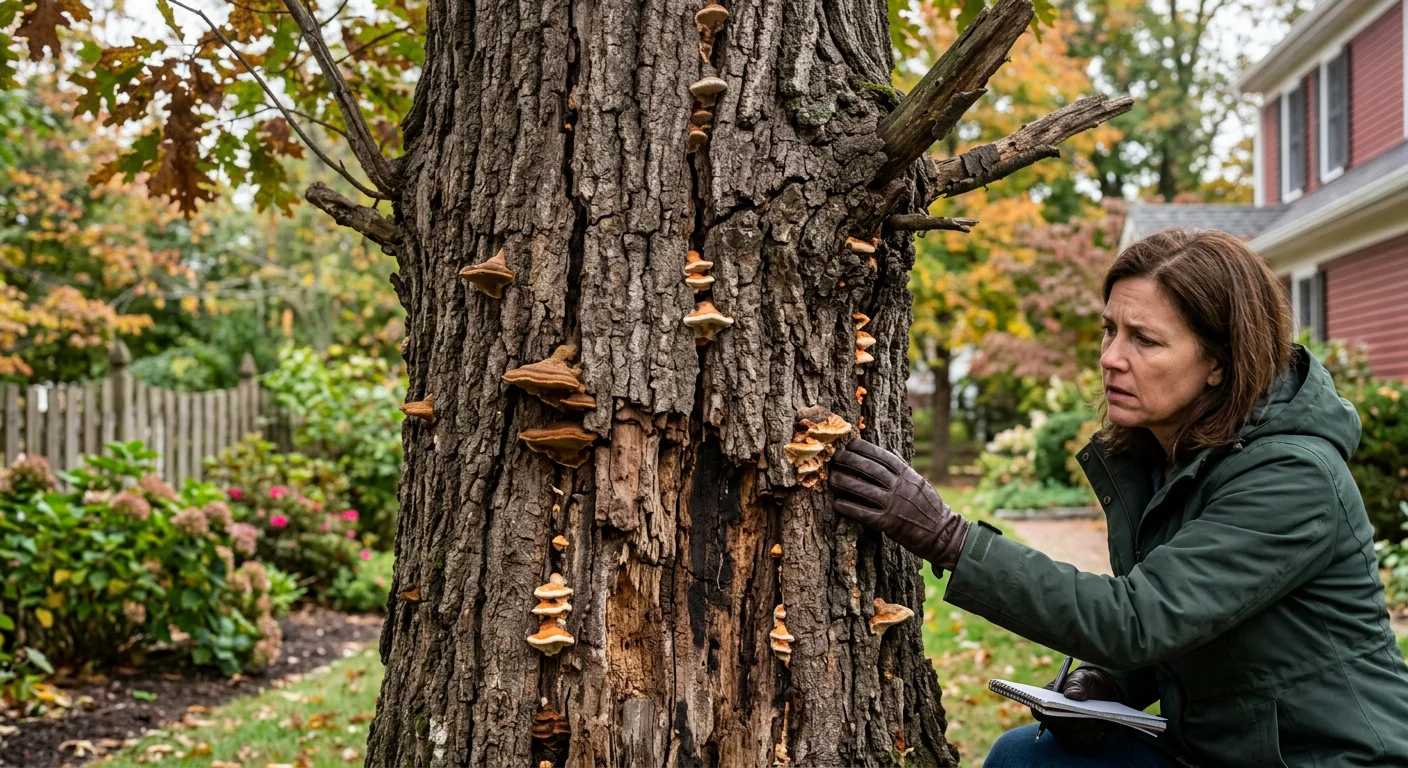
Visible signs of internal decay include: fungal conks (shelf mushrooms growing from the trunk or major roots), dark staining or oozing from bark wounds, soft or spongy wood near the base, and carpenter ant activity (ants don’t cause decay, but they excavate in soft decayed wood and their presence indicates it’s there).
3. Dead Branches in the Upper Canopy
Some deadwood in the inner canopy is normal — these are shade-killed lower branches that the tree sheds naturally. What’s not normal is significant deadwood in the upper, outer canopy, where living branches belong.
Large dead branches (4+ inches in diameter) in the upper canopy of a tree over your home or near a play area represent an active falling hazard. In New Castle County’s typical summer thunderstorm scenario — 30–40 mph wind gusts, heavy rain, saturated soil — upper canopy deadwood is the first thing to come down.
Delaware’s emerald ash borer problem has created a new category of upper canopy deadwood: ash trees showing top-down die-back from EAB infestation. If your ash tree’s upper canopy has been thinning over the past 2–3 years, EAB is likely the cause. Trees with more than 40% upper canopy loss are typically past the point where treatment makes economic sense — learn more on our tree health & disease treatment page.
4. Freeze-Thaw Cracking and Frost Cracks
Delaware winters create a specific type of tree damage that warmer climates don’t see: frost cracks. These are vertical splits in the bark — sometimes extending into the wood — caused by the rapid temperature changes between a warm winter afternoon and a cold night. Water that has entered bark crevices expands when it freezes, forcing the crack open further each cycle.
Look for vertical cracks on the south and southwest sides of tree trunks, which receive the most direct winter sun exposure and experience the largest temperature swings. Frost cracks can extend several feet vertically and go several inches deep. While trees can callus over frost cracks during growing season, the crack reopens every winter — and each cycle weakens the structural wood further.
In Brandywine Hundred and Hockessin neighborhoods, white oaks and red maples with frost cracks on their sun-exposed sides warrant assessment. A crack that reaches the heartwood is a structural concern.
5. Root Damage or Exposed, Failing Roots
The root system that keeps a 60-foot tree standing extends well beyond what’s visible. Roots can be compromised by construction work that cuts through them, soil compaction from equipment or vehicles parked repeatedly in the root zone, soil removal or grading near the tree, or flooding that removes soil and undermines root anchorage.
Signs of root problems at the surface: soil heaving or cracking in an arc around the base of the tree (indicating root plate lifting), exposed roots that are mushy or decayed, and lean that has developed relatively quickly.
In Brandywine Hundred neighborhoods adjacent to Brandywine Creek, periodic flooding regularly compromises root anchorage in creek-side trees. A tree that’s been flooded multiple times and is now showing any lean toward a structure is worth getting assessed immediately.
6. Multiple Trunks with Included Bark
Many residential trees — Bradford pears, silver maples, ornamental cherries — develop two or more main trunks arising from the same point on the tree. When these trunks grow together at a narrow angle, the bark gets “included” between them rather than forming a proper branch collar. This creates a structural weak point that worsens as the tree grows heavier.
You can identify included bark by looking at the junction between the stems: a healthy junction has a raised lip of bark (the branch collar) at the base of the attachment. An included bark situation shows a seam of dark, recessed bark — sometimes with a crack developing — where the two stems meet.
Bradford pears in Bear, Newark, and Middletown neighborhoods are the most common example. By the time a Bradford pear is 20+ years old, the co-dominant stem arrangement makes storm splitting nearly inevitable. We remove more split Bradford pears after summer storms than any other single species in New Castle County.
7. Proximity to Your Home, Power Lines, or Structures
This one isn’t about the tree’s health — it’s about location risk. A perfectly healthy, well-structured 70-foot tulip poplar that’s positioned so its fall zone reaches your roof is worth assessing even if it’s structurally sound.
The key calculation: what’s the potential consequence if this tree fails? A tree in an open yard with no fall-zone exposure is low-consequence even if it has some health concerns. A tree positioned within its height of your home, garage, or frequently occupied outdoor space is high-consequence even if it’s relatively healthy.
For Wilmington’s urban lots and the tight suburban lots in Elsmere, Claymont, and Newark, the proximity factor is often the most important consideration. There simply isn’t enough open space between trees and structures in these neighborhoods for a 50-foot tree to fall safely in any direction.
When to Call a Professional Tree Service in New Castle County
Any of the seven signs above warrants a professional assessment. The assessment visit itself is free with East Coast Tree Service — we’ll walk your property, evaluate every tree of concern, and give you an honest opinion on what needs action and what can wait. We serve Wilmington, Newark, Hockessin, Bear, New Castle, Middletown, Greenville, Pike Creek, Christiana, Odessa, and all of New Castle County, DE.
The most important thing is not to delay once you’ve noticed a sign. Trees don’t get better on their own once they’ve developed structural problems. Scheduling an assessment in March is almost always less expensive — and less stressful — than scheduling an emergency removal in August.
Call us at (302) 588-3955 or request a free estimate online. We respond to assessment requests within one business day.
Related Reading:
- Tree Trimming vs. Tree Removal: How to Decide — Not every problem tree needs to come down
- When Does a Leaning Tree Become Dangerous? — A deeper look at Sign #1
- How Much Does Tree Removal Cost in Delaware? — Price ranges for New Castle County
Frequently Asked Questions About Tree Removal in Wilmington, DE
How do I know if my tree needs to be removed or just trimmed?
The key factors are structural integrity and location risk. If a tree has significant internal decay, root failure, more than 50% dead canopy, or co-dominant stems with included bark — and it’s positioned where it could hit your home or a neighboring structure — removal is typically the right call. If the problem is isolated branches, overgrowth, or clearance issues and the trunk and roots are sound, tree trimming can solve it. We assess both options on every estimate visit and give you an honest recommendation.
How much does tree removal cost in Wilmington, DE?
Tree removal in the Wilmington area typically runs $300–$700 for small trees under 25 feet, $600–$1,800 for medium trees, and $1,200–$5,000+ for large hardwoods or trees with difficult access. Urban Wilmington jobs with tight lots often run 30–60% higher than equivalent suburban jobs due to rigging requirements. We provide free written estimates — call (302) 588-3955 to schedule.
Is a leaning tree always dangerous?
No. Trees that have grown at a consistent angle toward sunlight for decades have compensated for that lean structurally and are generally as stable as vertical trees. The danger sign is recent or progressive lean — lean that developed or worsened over the past season — especially if accompanied by soil heaving at the base. That indicates active root failure and warrants immediate attention.
Does homeowner’s insurance cover tree removal in New Castle County?
Homeowner’s insurance typically covers tree removal if a storm-damaged tree fell on a structure (roof, fence, garage) or is blocking your driveway. It generally does not cover removal of trees that fell in the yard without structural contact, or preventive removal of at-risk trees. Document everything before cleanup begins — photos are critical to claim approval.
How quickly can East Coast Tree Service respond to a dangerous tree in Wilmington?
For active hazards — trees on structures, trees contacting power lines, partially uprooted trees threatening a building — we respond 24/7. Call (302) 588-3955 any hour for emergency tree service. For non-emergency assessment scheduling, we typically respond within one business day.
Can you remove a tree that’s close to my house in Wilmington’s tight neighborhoods?
Yes. Tight-lot removal in Wilmington, Elsmere, Claymont, and New Castle is work we do regularly. We use rope rigging to lower sections piece by piece when there’s no clear fall zone. The additional rigging adds to the cost compared to an open-lot removal, but it’s the standard approach for urban tree work. We’ll assess the access situation and include the rigging plan in your written estimate.
How long does tree removal take in New Castle County?
Most residential tree removals take half a day to a full day depending on tree size, access, and whether stump grinding is included. Very large trees (75+ feet) with difficult access can extend to a second day. We give you a realistic time estimate before the job starts.
What areas does East Coast Tree Service serve in Delaware?
We serve all 13 communities in New Castle County: Wilmington, Newark, Bear, New Castle, Middletown, Hockessin, Greenville, Brandywine Hundred, Pike Creek, Claymont, Elsmere, Christiana, and Odessa. Free estimates throughout the service area.