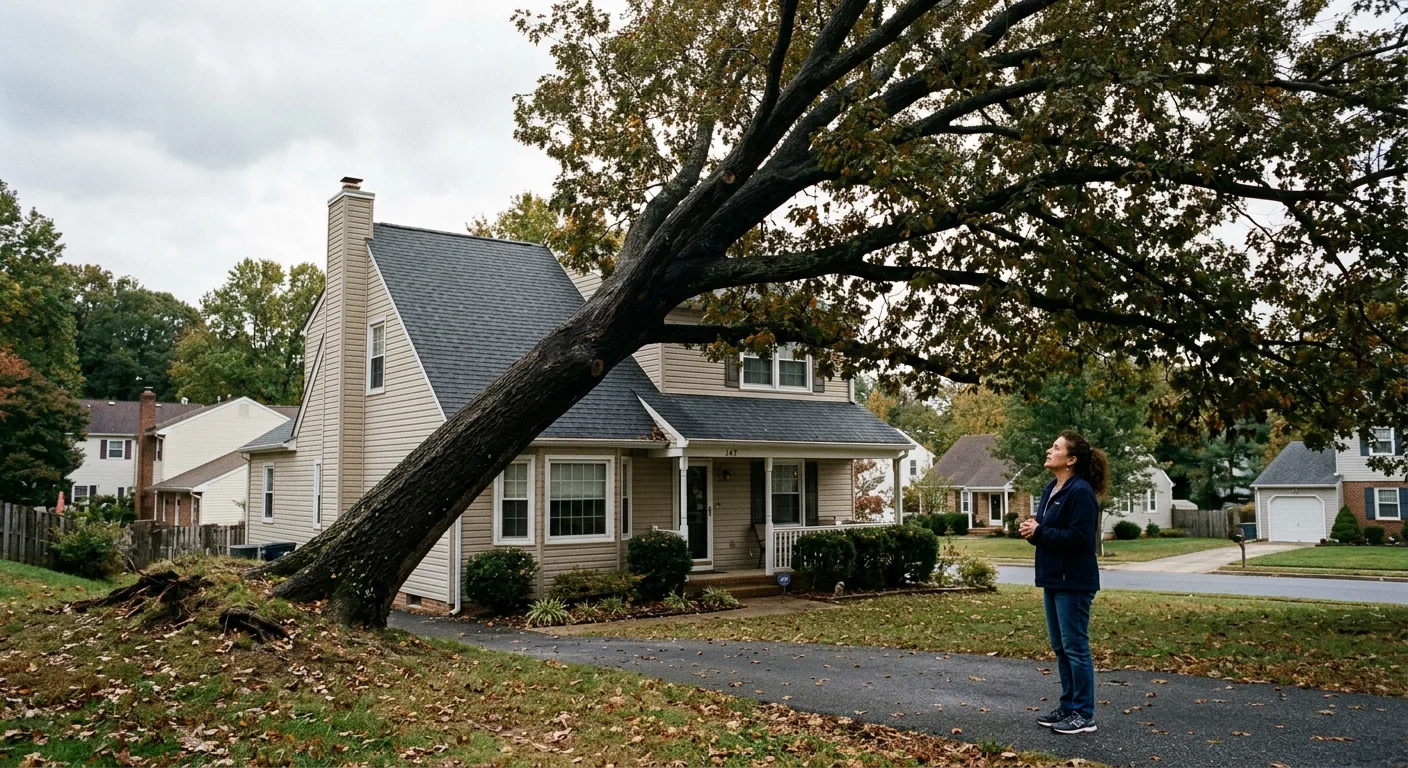
If you have a leaning tree on your property in Wilmington, Newark, Hockessin, or anywhere in New Castle County, Delaware, you’ve probably wondered whether it’s something to worry about. The answer varies enormously — and the lean itself isn’t the key indicator. What matters is why the tree is leaning and what has changed recently.
Every year our crew assesses leaning trees across New Castle County and gives homeowners an honest answer. Some of those trees are stable and low-risk. Others are actively in the process of failing and need emergency tree service that week. This guide helps you understand the difference.
Natural Lean vs. Progressive Lean in Delaware Trees
The first question is: has this tree always leaned, or did it start — or worsen — recently?
Natural lean occurs when a tree grows toward available light — typically toward a south or southeast exposure. Trees that have grown at a consistent angle for decades have compensated for that lean in their wood structure, developing reaction wood on the appropriate side to counteract the lean. These trees are generally as stable as a vertical tree of equivalent size.
The Wilmington and Alapocas neighborhoods are full of silver maples and pin oaks that have grown at 5–15 degree angles toward Delaware Avenue or toward sunlit openings for their entire lives. They’re not falling anytime soon.
Progressive lean — lean that has developed or worsened over a period of months to years — is a fundamentally different situation. Something has changed in the tree’s structural relationship to the soil, and that change represents active failure in progress.
What Causes Dangerous Tree Lean in New Castle County
Root Failure
The most serious cause of sudden progressive lean. When a tree’s root system can no longer bear the load of the above-ground structure, the root plate (the disk of roots and soil that anchors the tree) begins to lift on the opposite side of the lean.
Signs of root failure accompanying lean:
- Soil heaving or cracking in an arc on the opposite side from the lean direction
- Visible root plate lifting — you can see the top of the root system emerging from the soil
- Recent flooding or prolonged soil saturation that reduced root grip
- Recent grade changes, excavation, or construction near the tree that severed roots
In Brandywine Hundred and along the Brandywine Creek corridor, we see root failure lean most frequently in the weeks after major flood events. Trees that were stable for decades begin to lean as flooding saturates and undermines root anchorage.
Trunk or Root Decay
Internal decay can progress to a point where the trunk or root flare can no longer support the tree’s weight without leaning. The insidious part: the tree may look perfectly healthy above the decay zone. Green canopy, normal leaf size, no obvious external problem — but 40–60% of the trunk interior is gone.
Signs of decay-related lean:
- Fungal conks growing from the trunk at or below the lean point
- Soft, spongy wood if you probe near cavities
- The lean developed gradually without any obvious triggering event
- The lean point is at mid-trunk, not at the root flare (indicates upper trunk failure rather than root failure)
In older Wilmington neighborhoods, aging silver maples are the most frequent case — a tree that’s been growing without professional assessment for 30 years, developing internal decay through repeated bark wounds and branch stubs, eventually leaning as the decayed column can no longer hold.
Soil Saturation and Wet Season Lean
In New Castle County’s clay-heavy soils — particularly in Wilmington, Brandywine Hundred, and Pike Creek Valley — extended wet periods can temporarily reduce root grip to the point where trees begin to lean without any underlying structural problem.
This type of lean is the most benign: it’s often partially reversible as soils dry and root grip is restored. However, a tree that leans significantly during wet periods and returns to vertical as soils dry is showing you that its root anchorage is at or near its capacity. That tree warrants monitoring and assessment if it shows additional stress indicators.
Wind Loading and Crown Imbalance
A tree with significant asymmetric crown development — heavy on one side due to neighboring tree competition, previous storm damage, or aggressive one-sided pruning — can develop lean from constant wind loading on the heavy side. This is typically a slow process and usually not an emergency, but it warrants assessment and possible crown reduction to rebalance the load.
How to Assess a Leaning Tree Yourself
Before calling us, here’s a quick self-assessment you can do safely from the ground:
Look at the base:
- Is there soil cracking or heaving on the opposite side from the lean? (Root failure indicator)
- Do you see any fungal growth at the base? (Decay indicator)
- Is the bark at the base separating or peeling in unusual ways?
Look at the lean:
- Is this a lean that has always been there, or did it change recently?
- Did the lean worsen after a storm, flooding, or construction activity nearby?
- Is the lean accelerating — noticeably worse this month than last month?
Look at the canopy:
- Does the canopy appear healthy and full, or is it thinning?
- Are there large dead branches in the upper canopy that add weight without root support?
- Is the heavy side of the crown significantly heavier than the other?
Consider the consequence:
- What’s in the fall zone of this tree?
- How often is that space occupied?
- If this tree falls in the worst-case direction, what does it hit?
When to Call a Professional Tree Service in New Castle County Immediately
Stop self-assessing and call immediately if:
- The lean developed overnight or over a period of days (sudden lean = root failure)
- You see visible soil heaving or root plate lifting on the opposite side
- The tree is within its height of any occupied structure
- The lean has been worsening progressively over weeks or months
- There are fungal conks growing from the trunk near or below the lean point
- The tree is partially uprooted — root ball visible at the surface
For Wilmington, Hockessin, Greenville, Middletown, and other areas in New Castle County with older mature trees, we see these situations regularly and take them seriously. A tree in active root failure can complete its failure without warning, often during conditions that seem far less severe than the storm you expected would bring it down — a wet day, a moderate wind, a warm afternoon that follows a freezing night.
Trees That Are Not Dangerous Despite Looking Alarming
Not every leaning tree in New Castle County is dangerous, and we want to be honest about that.
A mature tulip poplar in a Newark backyard that has grown at a consistent 10-degree angle toward the sun for 40 years, with no soil disturbance and no sign of decay, is not an emergency. We assess it, confirm the lean hasn’t changed, verify no decay at the base, and advise monitoring.
A Leyland cypress hedge in a Bear neighborhood that leans slightly into the prevailing wind pattern, with no soil disturbance or fungal growth, is likely fine.
A small ornamental that leans significantly but has a fall zone entirely in your own lawn with no structure exposure is a low-consequence situation even if the lean is structural.
The combination of structural lean + fall zone exposure + occupancy frequency determines the actual risk level. We assess all three, not just the lean angle.
Free Tree Lean Assessment Across New Castle County, DE
If you’re concerned about a leaning tree in Wilmington, Newark, Hockessin, or anywhere in New Castle County, the right move is a professional assessment — not a phone conversation based on a description, and not a Google search. Every tree is different, and every site is different.
We assess leaning trees throughout New Castle County at no charge as part of any tree removal or service estimate. Call (302) 588-3955) or request an estimate online. We serve Wilmington, Newark, Bear, New Castle, Middletown, Hockessin, Greenville, Brandywine Hundred, Pike Creek, Claymont, Elsmere, Christiana, and Odessa.
Related Reading:
- 7 Signs Your Tree Needs to Be Removed — Lean is Sign #1, but there are 6 more to check
- What to Do After Storm Tree Damage in Delaware — Storms are the #1 cause of sudden lean
- How Much Does Tree Removal Cost in Delaware? — What to expect if removal is the right call
Frequently Asked Questions: Leaning Trees in Delaware
Is a leaning tree always dangerous in New Castle County, DE?
No. Trees that have grown at a consistent angle for decades are generally as stable as vertical trees — they’ve compensated structurally for the lean. The danger sign is recent or progressive lean, especially accompanied by soil heaving at the base. If the lean is new or worsening, that’s root failure in progress and warrants immediate professional assessment.
How much lean is too much for a tree near my house in Delaware?
There’s no universal angle threshold. A 15-degree lean that has been consistent for 20 years is less concerning than a 5-degree lean that developed over the past 3 months. The rate of change matters more than the absolute angle. If a tree near your home is leaning toward it and the lean has increased noticeably in the past season, call us for an assessment.
What should I do if my tree started leaning after a storm in New Castle County?
Call us immediately at (302) 588-3955. Post-storm lean that wasn’t there before almost always indicates root failure — the storm load shifted the root plate and the tree may be partially uprooted. Even if it looks stable, a tree in this condition can complete its failure with a much smaller trigger. Don’t park cars or let people stay near it until it’s been assessed.
Can a leaning tree be straightened or saved?
Occasionally — young trees (under 4-inch trunk diameter) with minor lean from wind or transplanting stress can sometimes be staked and trained back toward vertical. Mature trees with significant structural lean or root failure cannot be straightened and should not be attempted. For mature trees, the choice is removal or careful monitoring based on assessed risk.
How long does it take for a leaning tree to fall after root failure begins?
There’s no reliable timeline. A tree in active root failure could stand for another month or fail in the next strong wind event. The unpredictability is exactly why active root failure lean is treated as an emergency — we can’t tell you it’s safe to wait. If the tree is in a fall zone that includes your home or a regularly occupied space, treat it as urgent.
What does it cost to assess and remove a leaning tree in Wilmington, DE?
The assessment is free. Removal cost depends on tree size and access — typically $400–$2,500 for the leaning trees most homeowners call us about. We provide a written estimate at the site visit with no obligation.