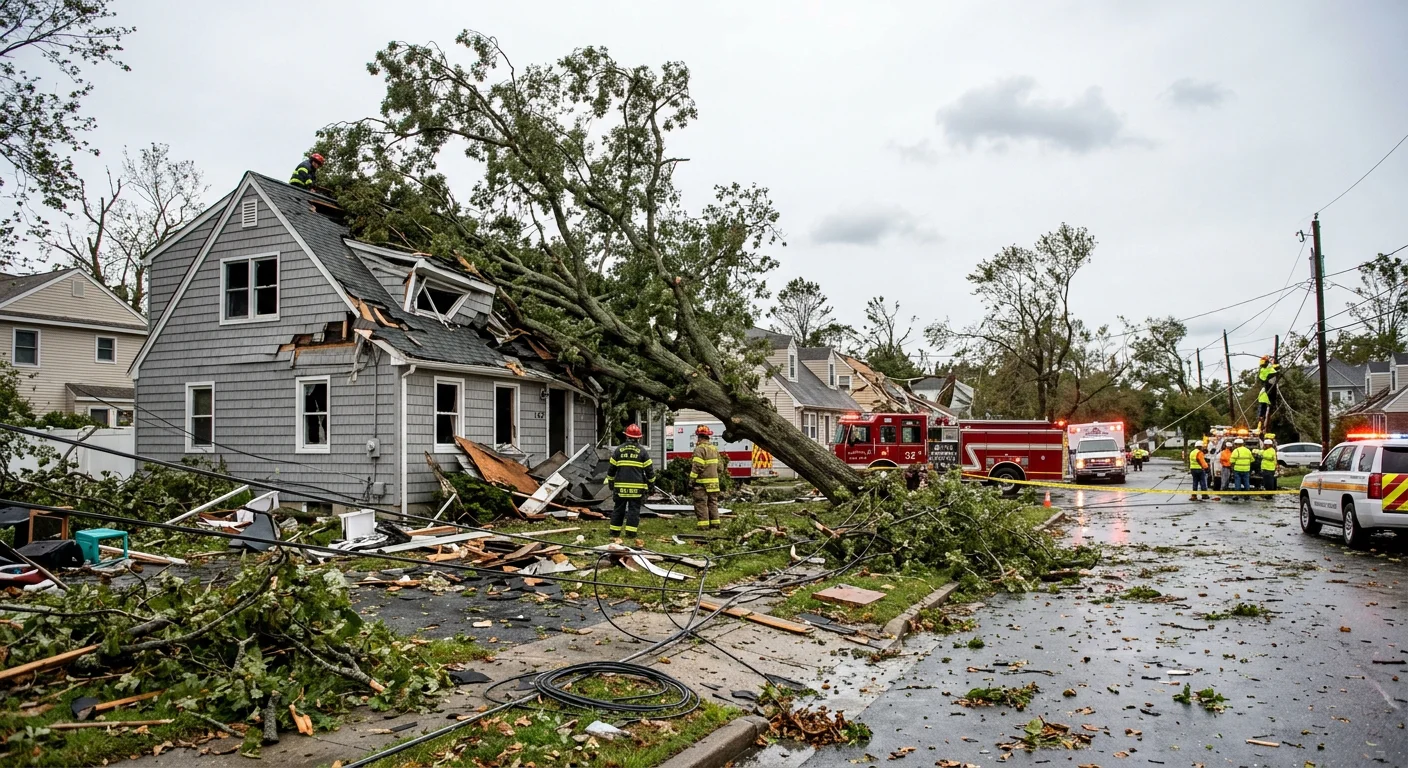
Delaware sits at the intersection of several major storm patterns — nor’easters tracking up the coast from the Carolinas, summer supercell thunderstorms pushing northeast through the Chesapeake corridor, and tropical systems that occasionally reach the Mid-Atlantic. New Castle County averages roughly 45 inches of rain per year and sees sustained winds over 40 mph multiple times each season.
When a major storm hits Wilmington, Newark, Bear, or anywhere in New Castle County, the first 24 hours after it passes matter enormously — both for your safety and for your insurance claim. This guide walks you through exactly what to do after storm tree damage in Delaware.
Step 1: Don’t Go Outside Until the Storm Fully Passes
This sounds obvious, but every storm season we receive calls from New Castle County homeowners who went out to check on their yard during a lull and were caught by a second band of wind and rain. A nor’easter in particular can have multiple intense periods separated by hours of relative calm.
Wait until conditions have fully stabilized before inspecting your property. The falling hazards that storm damage creates — suspended limbs, partially broken branches held up by surrounding trees, and root-tension in partially uprooted trees — are not going to hurt anyone if you stay inside. Going out early to assess is not worth the risk.
Step 2: Stay Clear of Downed Power Lines
Any downed line should be treated as energized and dangerous. If a tree has come down on or near a power line in Wilmington, Brandywine Hundred, Pike Creek, or anywhere in New Castle County, stay well back — at least 30 feet — and call Delmarva Power (1-800-375-7117) immediately. Don’t assume a line is dead because it’s not sparking. Electricity can arc or cycle back on.
If a tree has pulled a service drop (the line from the pole to your house) from your home’s weatherhead, call Delmarva Power for that too — even if the interior lights are still on. The pull can damage the weatherhead connection in ways that create a fire hazard that isn’t immediately obvious.
Step 3: Document Everything Before Cleanup Begins
Your homeowner’s insurance claim is built on documentation. Before any cleanup begins — and specifically before you call a tree service in New Castle County — take a thorough set of photographs and short videos:
- Wide shots showing the tree in context of your property and any structures
- Close-up shots of where the tree originated (root zone, trunk base)
- Close-up shots of any damage to structures, fencing, vehicles, or landscaping
- Photos from multiple angles showing the full extent of the fallen material
Store these in the cloud (Google Photos, iCloud) so you have them even if your phone is damaged. Then open your insurance claim — most companies now have apps or online portals that accept claims 24/7.
Why document before cleanup? Insurance companies may argue that a pre-existing condition caused the tree to fail rather than the storm — they need to see the evidence of storm causation. Cleaning up first and claiming later is a common mistake that complicates claims throughout Delaware.
Step 4: Identify Immediate Hazards vs. Cleanup Situations
Not all storm tree damage in New Castle County is the same. The response to an immediate hazard is different from the response to a cleanup situation.
Immediate hazard — call us for emergency tree service now:
- Tree actively resting on your home’s roof, walls, or attached structures
- Tree blocking your only exit route from the property
- Tree in contact with or tangled in utility lines
- Partially uprooted tree that is visibly moving in wind and threatening to fall on a structure
- “Widow maker” — large broken limb suspended in the canopy that could drop at any time
Cleanup situation — call us to schedule storm damage cleanup:
- Fallen tree that landed in the yard, clear of structures
- Debris on the lawn or driveway that’s not blocking emergency vehicle access
- Branches down in the garden or landscaping area
- Tree that partially fell but is now stable with the crown resting on the ground
If you’re unsure which category your situation falls into, call us at (302) 588-3955 and describe it — we’ll tell you whether to treat it as an emergency.
Step 5: Protect Any Interior Damage from the Weather
If a tree has breached your roof or a window in your Wilmington or New Castle County home, temporary weather protection is critical. Water damage from rain exposure compounds every storm quickly. If you can safely access the damaged area from inside the house (never from the roof while a tree is resting on it), cover the opening with tarps or plastic sheeting and document the interior damage before covering.
Your homeowner’s insurance typically covers reasonable temporary protective measures. Keep all receipts for tarps, plastic sheeting, or temporary board-up materials.
Step 6: Assess Trees That “Survived” for Secondary Hazards
The trees still standing after a major storm in New Castle County aren’t necessarily safe. Storm events create secondary hazards:
Hung trees: A tree that fell and is now suspended by neighboring trees rather than resting on the ground. These are among the most dangerous storm situations because the suspended weight is unpredictable. Stay well clear until we can assess it.
Widow makers: Large broken branches held in the canopy by other branches, sometimes barely visible from the ground. The same storm that knocked over other trees may have broken branches in your canopy that are waiting for the next gust to fall. Walk your yard after the storm and look up carefully.
Stressed root plates: Trees that didn’t fall but were heavily loaded during the storm may have cracked their root plates — the disk of roots and soil that keeps them standing. This isn’t visible from above, but new leaning, soil cracking around the base, or root lifting are indicators. Check your trees 2–3 days after a major storm for any changes.
Step 7: Contact Your Insurance Company
Open your claim as soon as it’s safe to do so. The claims process typically requires:
- Your policy number and the date and cause of loss
- Photos of the damage (which you took in Step 3)
- An estimate from a licensed tree removal company in New Castle County
East Coast Tree Service provides complete written documentation for insurance purposes including itemized scope of work, photographic record, and a description of the storm damage conditions we observed. This documentation is provided at no extra charge for all insurance-related storm cleanup jobs in Delaware.
What homeowner’s insurance typically covers in Delaware:
- Removal of storm-downed trees that landed on structures (roofs, garages, fences)
- Removal of storm-downed trees blocking driveways or emergency vehicle access
- Interior damage repair from tree impacts
- Reasonable temporary protective measures
What it typically doesn’t cover:
- Removal of fallen trees that landed only in the yard with no structural contact
- Removal of trees that are merely leaning toward structures but haven’t failed
- Preventive removal of “at-risk” trees (this must be paid out of pocket)
Delaware Storm Timing: When Trees Are Most at Risk
Nor’easters (October–April): Delaware’s most significant tree-damage storms. The combination of sustained high winds, rain-saturated soil that reduces root grip, and sometimes ice loading creates the conditions for the largest tree failures. Ice loading is particularly dangerous — a 2-inch ice accumulation on a large oak canopy can add thousands of pounds of load.
Summer thunderstorms (June–September): Sudden-onset storms with 40–60 mph microbursts create explosive single-event damage in Wilmington, Newark, Bear, and surrounding communities. Bradford pears, silver maples, and structurally compromised trees fail most often during summer storm events.
Tropical remnants (August–October): Tropical systems weakened to tropical storm strength occasionally reach New Castle County. They’re characterized by prolonged heavy rain that saturates soil before any significant wind arrives — creating the worst possible root-grip conditions for the winds that follow.
Emergency Storm Tree Service in New Castle County, DE
For emergencies — tree on a structure, contacting power lines, blocking egress — call us directly at (302) 588-3955 at any hour. East Coast Tree Service responds to active hazard emergencies around the clock, 24/7, throughout New Castle County.
For storm cleanup scheduling, call or request an estimate online. We serve Wilmington, Newark, Hockessin, Middletown, Bear, Brandywine Hundred, Pike Creek, Greenville, Christiana, Odessa, and all 13 communities in our service area. During major storm events, we triage by severity and work through our call queue as quickly as crew capacity allows.
Related Reading:
- When Does a Leaning Tree Become Dangerous? — Storm damage creates secondary lean hazards
- 7 Signs Your Tree Needs to Be Removed — Post-storm checklist for surviving trees
- How Much Does Tree Removal Cost in Delaware? — Emergency pricing and what insurance typically covers
Frequently Asked Questions: Storm Tree Damage in Delaware
Who do I call for emergency tree removal in Wilmington, DE after a storm?
Call East Coast Tree Service at (302) 588-3955 — we’re available 24/7 for storm emergencies throughout New Castle County. For trees on structures, power lines, or blocking egress, call us directly rather than waiting for an online estimate. We prioritize active hazards.
Will my homeowner’s insurance cover tree removal in New Castle County after a storm?
It depends on where the tree landed. Insurance generally covers removal if the tree fell on a structure (roof, garage, fence) or is blocking your driveway. It typically does not cover removal of trees that landed in an open yard with no structural damage. Document everything before cleanup — photos are your most important protection.
How soon can you respond to storm damage in New Castle County?
For active hazards (tree on a structure, power line contact), we respond around the clock. During major storm events affecting all of New Castle County, we work through calls by severity — a tree resting on your roof gets priority over a tree down in the yard. During wide-area storms, response times for non-emergency cleanup can extend to 1–3 days as we work through the queue.
What is a “widow maker” and how do I spot one after a storm?
A widow maker is a large broken branch that is suspended in the tree’s canopy, held up by other branches rather than fallen to the ground. They’re dangerous because they can fall without warning from a subsequent gust or ice melt. After a storm, look up into your canopy carefully — look for branches that appear broken or displaced but haven’t come down yet. Keep the area beneath any suspected widow maker clear until it can be professionally assessed and removed.
Do I need to remove a tree that fell in my yard but didn’t hit anything?
You’re generally not required to remove it, and insurance likely won’t cover it if there’s no structural damage. However, if the fallen tree is creating a secondary hazard (blocking drainage, supporting a hung limb that could fall on a structure), removal is worth doing. We’ll assess the situation and give you an honest opinion on urgency at no charge.
What areas do you cover for storm cleanup and emergency tree service in Delaware?
All of New Castle County: Wilmington, Newark, Bear, New Castle, Middletown, Hockessin, Greenville, Brandywine Hundred, Pike Creek, Claymont, Elsmere, Christiana, and Odessa.